Stripe Shut Down Your Account. Did Your Business Outgrew Stripe? What to Do in the Next 72 Hours.


The short answer
A Stripe closure feels like a crisis. New payments stop and Stripe can hold some or all of your balance to cover future refunds and chargebacks.
For many merchants, it’s a sign of growth. Stripe approves accounts at signup and then watches risk with automated models. Your sales jump, your average ticket rises, or disputes climb as order counts grow, and those models flag you. Your business stays yours, and so do your customers. In the first 72 hours, export your data, get the reason in writing, answer open disputes, and apply for a dedicated merchant account underwritten for the size you are now.
The email arrives without warning. Checkout stops working, your balance freezes, and every hour without payments costs you sales. Look at what set it off. Stripe built its model for fast signups and small, steady volume. When your sales outpace the profile Stripe approved, its risk systems read your growth as risk. A dedicated merchant account works the other way. A sponsor bank underwrites your business up front, sets limits for your real volume, and plans for your growth. This post walks you through the next 72 hours, explains why closures happen, and shows you how to move to a payments partner built to grow with you.
What happens when Stripe closes your account?
Your payments stop first. New charges fail at checkout, and any customer trying to buy sees an error.
Next, Stripe holds funds. A reserve is money a processor holds back from your payouts to cover refunds and chargebacks on sales you already made. Stripe does not publish a fixed hold period after closure. Its support pages say reserves normally run 30 to 90 days, and attorneys who handle Stripe disputes report post-termination holds of 90 to 120 days. Some run longer.
Your saved cards stay in Stripe's vault. If you run subscriptions, those card details matter. Stripe exports saved card data only on request and only to another PCI DSS Level 1 compliant processor, so plan for this early.
Your open disputes stay open, too. Every dispute you lose comes out of your held balance, which makes your dispute responses more important now than before the closure.
What should you do in the first 72 hours?
Hours 0 to 24: Protect your data and your record
Start by exporting everything from your Stripe Dashboard. Download your transactions, customers, disputes, refunds and payouts as CSV files. You need this history to apply for a new account, answer disputes and understand what went wrong. Do it now: Stripe's agreement does not oblige it to keep your data after the relationship ends, and its card data export does not include payment history or subscriptions.
Then reply to Stripe's closure email and ask for the reason in writing. Ask which policy applies and which activity triggered the review. Keep your reply short and factual. Anger won't reverse the decision, and a clear written record helps you later.
Finally, stop sending charges to Stripe. Pause checkout or route payments to a backup processor if you have one.
Hours 24 to 48: Get back to selling
Apply for a dedicated merchant account. Underwriters typically ask for three to six months of processing statements, your business formation documents, your refund policy, your fulfillment timelines, and Stripe's closure notice. Gather these before you apply and your review moves faster.
Once you choose a new processor, ask Stripe to export your saved card data to it. Stripe needs the new processor's PCI Attestation of Compliance (or its Visa service provider listing) and an encryption key before it sends the file. With the cards moved, you rebuild your subscription plans on the new platform and most subscribers keep paying without re-entering their cards. Cards saved through Stripe's Link wallet do not transfer.
Hours 48 to 72: Protect your balance and fix the cause
Answer every open dispute with evidence before its deadline. Each win protects money Stripe is holding.
Tell customers only what they need to know. Subscribers whose cards won't transfer need a link to update their payment method. Everyone else needs nothing from you.
Then find the cause. Before you process anywhere else, figure out what triggered the closure, so it doesn't follow you to the next processor.
Your 72-hour checklist
| Window | Action | Why it matters |
|---|---|---|
| Hours 0 to 24 | Export all Stripe data as CSV files | Your history powers your new application and your dispute evidence |
| Hours 0 to 24 | Get the closure reason in writing | Underwriters ask for it, and it tells you what to fix |
| Hours 24 to 48 | Apply for a dedicated merchant account | Every day without payments costs you sales |
| Hours 24 to 48 | Request your saved card data export | Subscribers keep paying without re-entering cards |
| Hours 48 to 72 | Answer every open dispute | Each win protects your held balance |
| Hours 48 to 72 | Find and fix the cause | The same problem follows you to the next processor |
Why does Stripe close accounts?
Most closures trace back to a handful of causes.
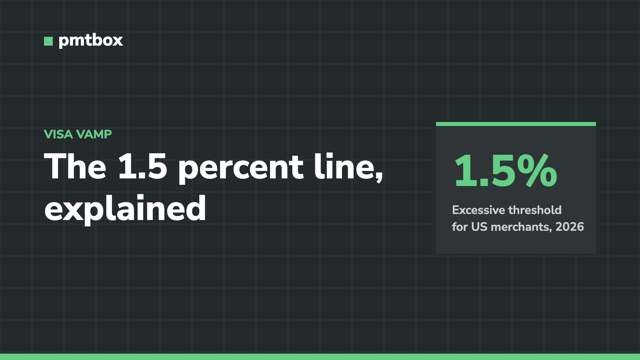
- Disputes and fraud above network limits: Since April 1, 2026, Visa labels a US merchant "Excessive" at a 1.5 percent ratio under the Visa Acquirer Monitoring Program (VAMP), down from 2.2 percent. The ratio counts fraud reports plus disputes, divided by settled card-not-present transactions, and Visa applies it once a merchant reaches 1,500 fraud and dispute events in a month. Processors step in well before you reach that line, because they carry the risk if you cross it. See our guide to Visa VAMP thresholds for 2026.
- Card testing: Bots run stolen cards through your checkout in small amounts to see which ones work. Declines and fraud reports spike within hours. Most merchants don't notice until approval rates drop or the processor places a reserve hold.
- Sudden volume jumps: A sales spike far above your history looks like risk to an automated model, even when it comes from a successful launch or a holiday rush.
- Restricted business types: Stripe publishes a list of businesses it restricts or prohibits, and a change in what you sell can put you on the wrong side of it.
- Long fulfillment windows: Pre-sales and long delivery times raise the chance of disputes on money Stripe already paid out to you.
Why do closures happen without warning?
Stripe works as a payment facilitator. A payment facilitator is a provider that lets many businesses process card payments under its own merchant account, so each business is a sub-merchant. Stripe approves you in minutes at signup and reviews your risk later, through automated models. Its Services Agreement lets it suspend or close an account at any time, and when its models flag your account, it can end the relationship to protect its own standing with the card networks.
A dedicated merchant account works the other way. A sponsor bank underwrites your business before you process a single sale. Your terms, reserves and pricing reflect your risk from day one, so growth and seasonality are planned for instead of flagged. Read more about shared payment accounts vs dedicated merchant accounts.
How do you get your held funds back?
Your fastest lever is your open disputes. Each one you win stays out of the reserve, so treat every response as money on the table.
Ask Stripe for your release schedule in writing and put the date in your calendar. Keep records of every refund and delivery confirmation, since proof of fulfillment wins disputes.
If funds stay held past the dispute window, read your agreement closely. Stripe updates its Services Agreement over time, so check the version tied to your account. An attorney who handles processor disputes can review your terms and tell you where you stand.
How do you keep it from happening again?
Closures rarely come from nowhere. The warning signs show up in your data first.
- Watch your VAMP ratio every week, not every month. A ratio climbing from 0.6 percent to 1.1 percent tells you to act long before a processor does.
- Catch card testing in the first hour. Look for bursts of small transactions, high decline rates from one location or device, and many cards tried against a single account.
- Represent every chargeback. Sort the causes by category: delivery issues, product issues, and others. Each category points to a different fix in your operations.
- Work with a partner who calls you first when your numbers move, instead of one who sends a closure email.
How pmtbox helps
pmtbox is an end-to-end payments partner. We are a registered ISO of Commercial Bank of California and Chesapeake Bank, and we underwrite your business up front, so your account rests on an approval made before you process.
We see your full transaction lifecycle: shopping cart, payments, fraud attempts, disputes and chargebacks. That view lets us spot card testing early, before it drags down your approval rates or triggers a reserve hold.
With Fraud Ownership, we cover the full cost of every fraudulent transaction our system approves. With Chargeback Automation, we represent your disputes automatically, and your team collects no documents. When you call, a real person answers, and one number covers your fraud, disputes and payments.
We earn more only when your approved sales grow, which ties our revenue to yours.
Tell us your monthly card volume, your industry, the reason Stripe gave, the date your funds froze and whether you are on the MATCH list, and a real person will walk you through your options. Talk to the pmtbox team.
Frequently asked questions
Does Stripe reverse an account closure?
Sometimes, but do not plan around it. Ask for the reason in writing and respond with facts and documents. Line up a new processor while you wait for an answer.
How long does Stripe hold funds after closing an account?
Stripe sets the hold based on your risk of future refunds and chargebacks and does not publish a fixed period for closed accounts. Its reserve guidance cites 30 to 90 days as normal, and attorneys who handle these cases report 90 to 120 days after termination. Ask Stripe for your release date in writing.
Will I end up on the MATCH list?
Not always. Mastercard's MATCH list records merchants terminated for specific reasons, such as excessive chargebacks or fraud, and a listing generally stays for five years. Ask Stripe whether your business was reported. Our MATCH list guide explains the reason codes and what a listing means for your next application.
Should I open a new Stripe account?
No. Stripe's Services Agreement bars a user whose account was suspended or terminated from creating another Stripe account unless Stripe approves. A second account that gets closed makes underwriting harder everywhere.
How fast do I get a new merchant account?
It depends on your business, your history and your documents. Having your processing statements, formation documents, refund policy and closure notice ready is the biggest factor you control.
Do I lose my subscription customers?
Not if Stripe exports your saved card data to your new processor and you rebuild your plans there. Request the export as soon as you choose a PCI DSS Level 1 compliant processor. Cards saved through Link do not transfer, so those customers need an update link.
Sources
- Visa VAMP's Tighter Threshold Is Now Live: What Merchants Need to Know, Justt
- Request a payment data export, Stripe Docs
- Stripe Services Agreement, Stripe
- Reserves, Stripe Support
- Prohibited and Restricted Businesses, Stripe
- Stripe Disputes FAQ, terms.law
- MATCH List, Chargebacks911