The short answer
A rolling reserve is a share of your daily sales that your processor or acquiring bank holds back to cover future chargebacks, refunds and fraud. chargeback.io cites reserves of 5 to 15 percent of sales, held for 30 to 180 days, then released on a rolling schedule, in What is a Rolling Reserve for Merchant Accounts? (August 14, 2026). A reserve protects your processor and ties up cash you need to run your business.
How does a rolling reserve work?
Each day, your processor keeps a fixed percentage of your settled sales. After the hold period ends, it releases that day's reserve back to you, while still holding back a share of new sales. The reserve rolls forward with your business.
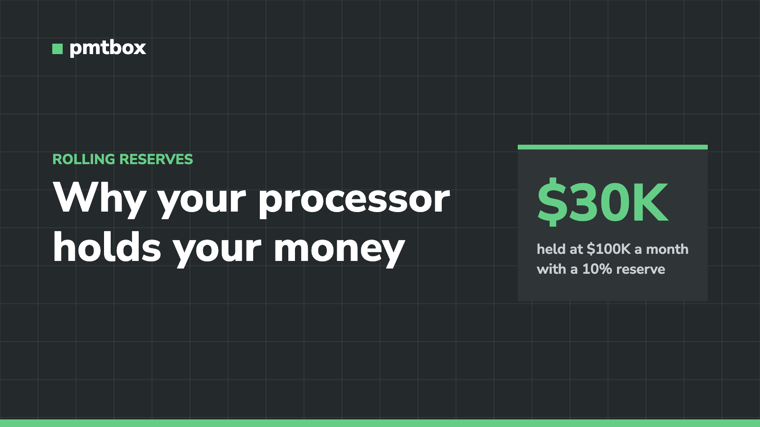
At $100,000 a month, or about $3,333 a day, a 10 percent reserve held for 90 days withholds about $333 each day. After 90 days, each day's release matches each day's new withholding, and the balance levels off at about $30,000 (90 days times $333). That $30,000 is your money, sitting with your processor at any given time.
At $100,000 a month, a 10 percent reserve held for 90 days ties up about $30,000 of your cash.
What are the main types of reserves?
| Type | How it works |
|---|---|
| Rolling | A fixed percentage of each day's sales, held for a set period, then released on a rolling schedule |
| Capped | A percentage of sales is withheld until the reserve balance reaches a dollar ceiling, then withholding stops |
| Fixed or minimum | The processor holds a set dollar amount, built from withheld payouts or a deposit, for as long as the terms require |
| Upfront | A lump sum collected at account opening, before you process, and released after the account performs |
A reserve is different from a funding hold. A funding hold delays a payout, usually for days. A reserve holds a share of your money for months.
Why do processors add reserves?
Processors add reserves when they see risk of losses they would have to cover. Common triggers include:
- A rising dispute or fraud ratio
- A card testing attack
- A sudden jump in sales volume
- Long fulfillment windows, such as pre-sales
- A new business with no processing history
- An industry with higher dispute rates
You stay responsible for refunds and disputes on past sales after an account closes, according to Stripe's Refunds and disputes after closing a Stripe account (Stripe Support, accessed November 16, 2026), so a processor that ends the relationship often keeps funds in reserve for months to cover them. A processor that relies on automated monitoring can add a reserve as soon as its model flags your account.
How do you get a reserve reduced or released?
Start by getting the terms in writing: the percentage, the hold period, the release schedule and the date of the next review. You can't negotiate terms you haven't seen.
Then build the case. Processors review reserves over time and can remove, reduce or extend them, according to Stripe's Reserves: Frequently Asked Questions (Stripe Support, accessed November 16, 2026). Show a steady, low dispute rate over several months. Fix the causes behind your disputes, stop card testing, and share financial statements that show your business can cover refunds. Ask for a cap, so withholding stops at a set dollar amount. If your reserve came from a sales spike, show the order data behind it.
If your processor won't move, look for a partner who underwrites your business up front. A reserve set during underwriting reflects a review of your actual business. A reserve added by an automated model reflects what the model inferred from your recent activity.
How pmtbox helps
We underwrite your business before you process, so your starting terms, including any reserve, come from a review of your business. Like any processor, we review reserve terms over time, and they change as your dispute and fraud results change.
We own approval rates and dispute results directly. We watch checkout, payments, fraud and disputes in one place, so we catch common causes of reserves, such as card testing and rising disputes, before they reach your payouts. With Fraud Ownership, we cover the full cost of any fraud we approve. Approved fraud still produces fraud reports, so prevention stays first. Chargeback Automation answers your disputes and recovers revenue.
Schedule a call about your reserve and your processing terms.
View Outcomes to see Fraud Ownership and Chargeback Automation in detail.
Frequently asked questions
How do you get money back from a rolling reserve?
Get the reserve terms in writing, lower your dispute and fraud rates, and ask for a cap or an early review once your numbers hold steady for several months.
What is a rolling reserve?
Your processor withholds a percentage of each day's sales and releases each day's amount once its hold period ends, so the held balance moves forward with your sales.
How much is a typical rolling reserve?
chargeback.io cites 5 to 15 percent of sales. Braintree publishes a typical range of 1 to 20 percent, with a default of 5 percent, in Reserves (Braintree Developer Documentation, accessed November 16, 2026).
How long does a processor hold a reserve?
chargeback.io cites hold periods of 30 to 180 days per transaction, released on a rolling schedule. Higher-risk accounts can see longer holds, and processors can extend a reserve when they review it.
What's the difference between a reserve and a funding hold?
A funding hold delays one payout for a few days. A reserve withholds a share of every sale for months.
Does Stripe use rolling reserves?
Yes. Stripe says it uses fixed and rolling reserves, reviews them before they expire, and can remove, reduce or extend them, in Reserves: Frequently Asked Questions (Stripe Support, accessed November 16, 2026). You remain responsible for refunds and disputes after a Stripe account closes.
If Stripe has closed your account, see our guide on what to do in the first 72 hours.
Sources
- Reserves, Braintree (PayPal) Developer Documentation, accessed November 16, 2026
- What is a Rolling Reserve for Merchant Accounts?, chargeback.io, August 14, 2026
- Reserves: Frequently Asked Questions, Stripe Support, accessed November 16, 2026
- Refunds and disputes after closing a Stripe account, Stripe Support, accessed November 16, 2026
Related guides
- Stripe Shut You Down. What To Do Next. Why It Could Be Good News for Your Business.
- Card Testing: How to Spot an Attack in the First Hour
- Shared vs Dedicated Merchant Accounts: Why Shared Accounts Close
See open roles on our Careers page.
Media contact
Jenny Lieb, Head of Marketing & Expert Services, jlieb@pmtbox.com