Rolling Reserves Explained: Why Your Processor Holds Your Money and How to Get It Back

The short answer
A rolling reserve is a share of your daily sales that your processor or acquiring bank holds back to cover future chargebacks, refunds and fraud. Industry sources commonly cite reserves of 5 to 15 percent of sales, held for 30 to 180 days, then released on a rolling schedule. A reserve protects your processor. It also ties up cash you need to run your business.
How does a rolling reserve work?
Each day, your processor keeps a fixed percentage of your settled sales. After the hold period ends, it releases that day's reserve back to you, while still holding back a share of new sales. The reserve rolls forward with your business.
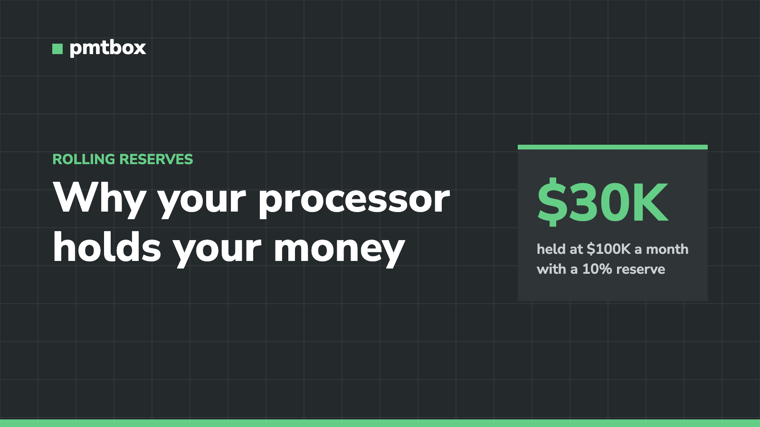
Here is what it means in dollars. You process $100,000 a month, or about $3,333 a day, under a 10 percent reserve held for 90 days. Each day about $333 goes into the reserve. After 90 days, each day's release matches each day's new withholding, and the balance levels off at about $30,000 (90 days times $333). That $30,000 is your money, sitting with your processor at any given time.
At $100,000 a month, a 10 percent reserve held for 90 days ties up about $30,000 of your cash.
What are the main types of reserves?
| Type | How it works |
|---|---|
| Rolling | A fixed percentage of each day's sales, held for a set period, then released on a rolling schedule |
| Capped | A percentage of sales is withheld until the reserve balance reaches a dollar ceiling, then withholding stops |
| Fixed or minimum | The processor holds a set dollar amount, built from withheld payouts or a deposit, for as long as the terms require |
| Upfront | A lump sum collected at account opening, before you process, and released after the account performs |
A reserve is different from a funding hold. A funding hold delays a payout, usually for days. A reserve holds a share of your money for months.
Why do processors add reserves?
Processors add reserves when they see risk of losses they would have to cover. Common triggers include:
- A rising dispute or fraud ratio
- A card testing attack
- A sudden jump in sales volume
- Long fulfillment windows, such as presales
- A new business with no processing history
- An industry with higher dispute rates
Merchants stay responsible for refunds and disputes on past sales after an account closes, so a processor that ends the relationship may keep funds in reserve for months to cover them. Many reserves arrive without warning. A processor that relies on automated monitoring can add one as soon as its model flags your account.
How do you get a reserve reduced or released?
Start by getting the terms in writing: the percentage, the hold period, the release schedule and the date of the next review. You can't negotiate terms you haven't seen.
Then build the case. Processors review reserves over time and can remove, reduce or extend them. They look for a steady, low dispute rate sustained over several months. Fix the causes behind your disputes, stop card testing, and share financial statements that show your business can cover refunds. Ask for a cap, so withholding stops at a set dollar amount. If your reserve came from a sales spike, show the order data behind it.
If your processor won't move, look for a partner who underwrites your business up front. A reserve set during underwriting reflects a review of your actual business. A reserve added by an automated model reflects what the model inferred from your recent activity.
How pmtbox helps
pmtbox underwrites your business before you process, so your terms are based on a review of your business from day one.
We see your full transaction lifecycle: shopping cart, payments, fraud attempts, disputes and chargebacks. That view helps us catch the problems behind many reserves, such as card testing and rising disputes, before they reach your payouts. With Chargeback Automation, we represent your disputes automatically. With Fraud Ownership, we cover the cost of fraudulent transactions our system approves. And when your numbers move, we call you first.
Talk to the pmtbox team about your reserve and your processing terms.
Frequently asked questions
What is a rolling reserve?
A rolling reserve is a share of your daily sales that your processor holds back for a set period to cover future chargebacks, refunds and fraud. Each day's withheld amount is released when its hold period ends.
How much is a typical rolling reserve?
Industry sources commonly cite 5 to 15 percent of sales, and Braintree publishes a typical range of 1 to 20 percent. Low-risk merchants with a strong history often carry no reserve.
How long does a processor hold a reserve?
Hold periods commonly run 30 to 180 days per transaction, released on a rolling schedule. Higher-risk accounts can see longer holds, and processors can extend a reserve when they review it.
What's the difference between a reserve and a funding hold?
A funding hold delays a payout, usually by days. A reserve holds a share of your money for months.
Does Stripe use rolling reserves?
Yes. Stripe says it uses fixed and rolling reserves, reviews them before they expire, and may remove, reduce or extend them. Merchants remain responsible for refunds and disputes after a Stripe account closes. If Stripe has closed your account, see our guide on what to do in the first 72 hours.
Sources
- Reserves, Braintree (PayPal) Developer Documentation
- What is a Rolling Reserve for Merchant Accounts?, chargeback.io
- Reserves: Frequently Asked Questions, Stripe Support
- Refunds and disputes after closing a Stripe account, Stripe Support